
From: Jesse Zeman, B.C. Wildlife Federation
To: Hon. Randene Neill, Minister of Water, Land and Resource Stewardship
Date: August 13, 2026
Dear Minister Neill,
I am writing on behalf of the B.C. Wildlife Federation to express our serious concern and disappointment with the decision to rescind the temporary fish-protection order on the Salmon River as well as the provincial ramifications of this decision as it relates to the future of fish in a number of systems across British Columbia.
We understand the extraordinary circumstances facing farmers and ranchers as a result of drought and wildfire risk. Public safety is critically important. However, the decision to rescind the order raises a fundamental question about how the Province is applying its own Water Sustainability Act: why is a fish-protection order being rescinded to address a fire-protection concern when the Act itself contains specific provisions dealing with fire protection?
The Water Sustainability Act is clear: Section 6 specifically provides that a person is not prohibited from diverting or storing and beneficially using water from a stream or aquifer for extinguishing a fire. Where water is diverted from a stream channel for that purpose, the flow must be promptly restored when the fire is extinguished.
Section 88 serves a different and equally important purpose. It allows the Minister to make an order when the flow of water in a stream is, or is likely to become, so low that the survival of a population of fish may be or may become threatened. The Minister must give due consideration to agricultural users, but the purpose of the order is the protection of fish populations.
The Act therefore provides separate tools for these circumstances. Section 6 addresses fire protection. Section 88 addresses fish protection. Using the fire threat as the reason to rescind Section 88 fish protection order risks undermining the very purpose for which Section 88 was enacted.
The Salmon River order was working
The evidence from the Salmon River is compelling. The Section 88 order came into effect on July 28, 2026. The BC Provincial Ministerial Order states that flow had fallen below 0.625 cubic metres per second and that it was so low that the survival of the Chinook salmon population had become threatened.
This threshold is particularly striking when compared with 2023. The 2023 Salmon River protection order was triggered when flow had fallen below 1.27 cubic metres per second. In fact, the Salmon River had approximately twice as much flow on August 15, 2023, when the Province issued its protection order, as it had in July of this year.
The BC River Forecast Centre’s July 27, 2026 data also showed a 7-day average discharge of only approximately 0.27 cubic metres per second in the Salmon River near Salmon Arm. The attached graph provides an important visual demonstration of what happened after the 2026 order was imposed.
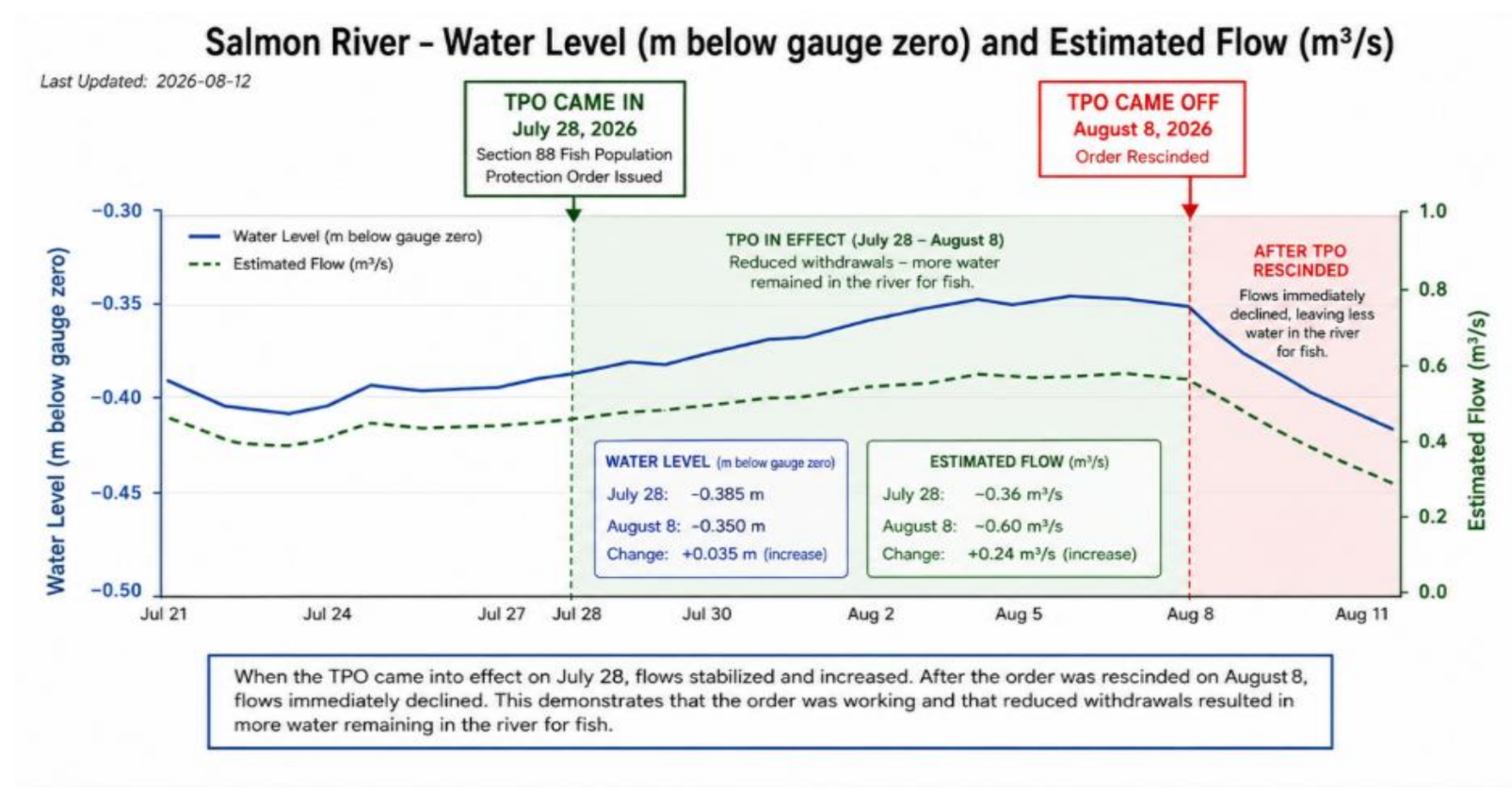
When the TPO came into effect on July 28, water levels stabilized and then increased. After the order was rescinded on August 8, water levels immediately began to decline. This is exactly what we would expect if reduced withdrawals were leaving more water in the river.
More importantly, the day after the original order was put in place, the DFO fish trap recorded approximately 50 Endangered Chinook salmon.
The order worked. It provided water in the river at a time when fish needed it.
We should not wait until fish are dead.
We should not wait until the Salmon River dries up, water temperatures become extreme, fish passage is lost, and Endangered Chinook are stranded or killed before government acts. The consequences of low flows are well understood. As flows decline, available fish habitat is reduced, water temperatures can increase, pools can become isolated, fish passage can be impeded, and fish can become stranded.
Juvenile Chinook are rearing in the system year-round, and if pools become isolated, we can expect 80-90% or more mortality due not only to high water temperature but predation – this will be devastating to this stream-type rearing population. Stream-type Chinook salmon in the interior Fraser River watershed have been mostly imperiled over the last decade and severe cutbacks in harvest have been made in an attempt to recover these populations at risk.
There are also juvenile Interior Fraser Coho (IFC) in the river which will experience similar mortality. While we have experienced improving returns over the past three years, populations IFC have been at risk since the 1990s with severe restrictions in harvest as well.
Any adult Chinook that have already entered the Salmon River will be extremely stressed due to compromised holding-space and high temperatures. Confining these fish to restricted and shallow holding areas will result in high risk of predation from ospreys, eagles and coyotes. Removing the protection order will impact two back-to-back cohorts (year classes) of already endangered Chinook which will create an extremely challenging recovery that will likely last for 3 generations or more (9 to 15 years).
The Canada Fisheries Act provides important protections in these circumstances, and we have approached the relevant federal agency to begin an investigation.
Section 34.4 prohibits carrying out a work, undertaking or activity that results in the death of fish. Section 35 prohibits carrying out a work, undertaking or activity that results in the harmful alteration, disruption or destruction of fish habitat. Section 38 provides important notification, inspection and enforcement authorities in relation to these protections.
If water withdrawals contribute to conditions that result in fish mortality or the harmful alteration, disruption or destruction of fish habitat, the Province should not be waiting until those impacts occur before taking action.
The purpose of section 88 of the WSA is to allow government to act before fish populations are harmed.
The broader message to British Columbians
Perhaps the most concerning consequence of this decision is the message it sends to water users across British Columbia. There are existing fish-protection orders and voluntary water reductions throughout the province. Those measures depend not only on government enforcement, but on the willingness of water users to voluntarily reduce their water use because they understand that rivers and fish need water too.
By rescinding this order while streamflows remain critically low, the government has sent a clear signal that water for fish is not important when there are competing demands for that water. This will inevitably affect compliance within the Water Sustainability Act and as well as voluntary restrictions.
The people who are trying to balance their water use with the needs of fish — the people who voluntarily reduce their withdrawals, change irrigation schedules and make sacrifices to leave water in rivers — will see that good stewardship is not appreciated or rewarded.
Why would a water user voluntarily give up water to protect fish if the government subsequently tells them that those efforts are unnecessary when conditions become difficult? The result will be reduced compliance with existing orders and voluntary reductions across the province.
This will be particularly visible in the Interior, where we have a number of endangered Chinook, Coho, and Steelhead populations already facing severe habitat and flow constraints. These are not hypothetical populations. They are among the fish populations for which government has a responsibility to maintain functioning aquatic ecosystems and for which every additional pressure can have significant consequences.
Section 88 cannot become meaningless.
Section 88 exists for circumstances like this. The legislation allows the Minister to restrict the diversion, rate of diversion, timing of diversion or use of water when fish survival is threatened, regardless of the precedence of water rights, after giving due consideration to agricultural users.
The Province exercised that authority on July 28. This was the right decision. It then rescinded the order on August 8, even though the Province’s own news release acknowledged that streamflows remain low and encouraged water users to continue voluntary conservation.
That creates an obvious contradiction. If conditions remain sufficiently serious that government is asking water users to voluntarily conserve water so that it remains available for firefighting and fish, then why remove the statutory mechanism that ensures adequate water remains in the river for fish?
If section 88 can be suspended at precisely the point when fish are most vulnerable because another water demand has become more pressing, then the provision becomes effectively meaningless further imperiling a number of at risk and endangered salmon populations as well as our cultural identity as British Columbians.
That sends a very troubling signal to British Columbians: that the Province is prepared to establish statutory protections, ask citizens to make sacrifices to comply with those protections, and then abandon them when competing interests become difficult.
That is not good water management, and it is not a credible approach to recovering endangered fish populations.
We respectfully ask that you:
1. Immediately reconsider the decision to rescind the Salmon River Section 88 fish population protection order.
2. Maintain sufficient instream flow to protect the survival and passage of Endangered Salmon River Chinook.
3. Clearly distinguish the statutory authority for fire protection under Section 6 of the Water Sustainability Act from the fish-protection authority provided under section 88.
4. Explain why the scientific basis for the current 0.625 m³/s order in July triggering intervention in 2026 is less than half of the 1.27 m³/s threshold used in 2023.
5. Release the scientific, hydrological and fisheries analysis relied upon to conclude that rescinding the order would not jeopardize juvenile and adult Chinook survival, including any analysis of streamflow, water temperature, fish passage and fish mortality.
6. Work with agricultural water users, First Nations, local governments, DFO and conservation organizations to identify alternative water storage, supply and firefighting measures that do not require sacrificing the minimum flows necessary for Chinook survival.
The Salmon River Chinook population cannot afford to wait until the river is dry, temperatures are extreme and fish are stranded or dead before government responds. The WSA gives the Province the authority to act before that happens.
Section 88 was created for this circumstance. We urge you to use it.
The B.C. Wildlife Federation is prepared to work constructively with your ministry, agricultural water users and other partners to find solutions that protect both public safety and fish. These objectives should not be presented as mutually exclusive when the Province has legislative tools available to address both.
We ask that you reconsider this decision immediately, before conditions deteriorate further.
Sincerely,
Jesse Zeman
Executive Director
B.C. Wildlife Federation
&
Glenn Flynn
President
B.C. Wildlife Federation